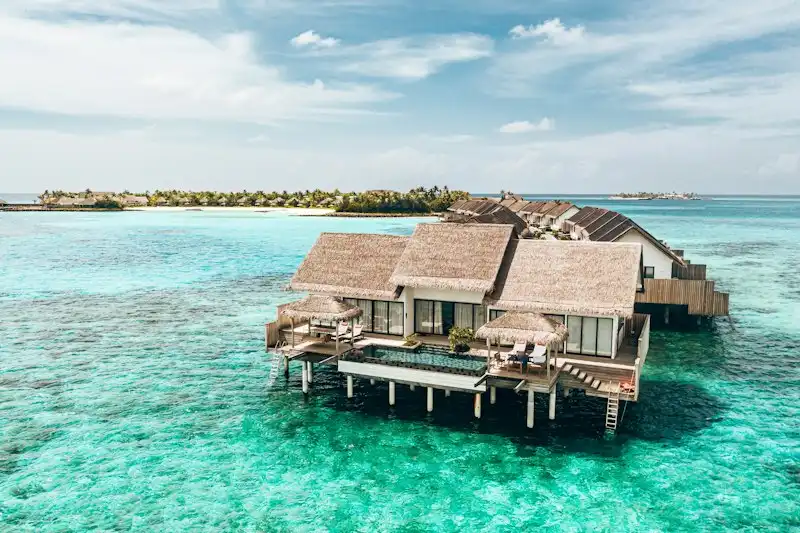

The Maldives is an Islamic country of 1,192 islands, and the rules change once you leave a resort. Alcohol is only sold on resort islands, modest dress applies on local islands, and you must complete the free IMUGA declaration within 96 hours of landing. Transfers go by speedboat, seaplane or domestic flight from Velana airport.
Month by month
| Month | High | Low | Rain | Price level | Crowds | What to expect |
|---|---|---|---|---|---|---|
| January Best | 30°C | 26°C | 114 mm | High | High | North-east monsoon (dry season); long sunny spells, though early-month showers linger after December. |
| February Best | 31°C | 26°C | 38 mm | High | High | Driest month in the Malé record; north-east monsoon brings the most sunshine of the year. |
| March Best | 31°C | 26°C | 74 mm | High | High | Dry and sunny, and one of the warmest months before the south-west monsoon. |
| April Best | 32°C | 27°C | 123 mm | High | High | Transitional month; hottest on average, with showers becoming more frequent. |
| May | 31°C | 26°C | 219 mm | Low | Low | South-west monsoon arrives mid-month; wettest spell of the first half of the year. |
| June | 31°C | 26°C | 167 mm | Low | Low | Wet season; regular showers between sunny periods. Whale shark season in Baa Atoll begins. |
| July | 31°C | 26°C | 150 mm | Medium | Medium | South-west monsoon continues; slightly less rain than May and June on average. |
| August | 30°C | 26°C | 176 mm | Medium | Medium | Wet season; showery days, with plankton feeding drawing whale sharks to Hanifaru Bay. |
| September | 30°C | 25°C | 199 mm | Low | Low | Wet season with frequent showers; a quieter month for arrivals and a good surf window. |
| October | 30°C | 25°C | 194 mm | Medium | Medium | South-west monsoon still active; showery, warm days and good surf conditions. |
| November | 30°C | 25°C | 231 mm | High | High | Wettest month in the Malé record as the south-west monsoon ends; arrivals pick up. |
| December | 30°C | 25°C | 217 mm | High | High | Transitional month towards the dry season; still showery, but the busiest month for arrivals. |
How the Maldives is laid out: resort islands and local islands
The Maldives is made up of 1,192 islands that stretch for 871 km across the equator, grouped into a double chain of 26 natural atolls (ring-shaped coral reef groups). Dry land covers only 298 sq km of a territory of about 90,000 sq km, so almost everything you see is lagoon, reef and open sea.
Only about 200 islands are inhabited. A select few in each reef group are resorts, where the island is given over to guests and staff, and others are used for industry and farming. The rest of the inhabited islands are ordinary Maldivian communities, often called local islands, with homes, mosques, schools and, increasingly, guesthouses.
That split shapes your trip more than anything else. On a resort island alcohol is served and the resort sets the dress code. On a local island Maldivian law and customs apply in full: no alcohol, modest dress and more care during Ramadan.
The international gateway, Velana International Airport, sits on its own island, Hulhulé, beside the capital Malé. The airport operator also runs the Noovilu Seaplane Terminal there. Malé and the neighbouring island of Hulhumalé are home to the country's only fully equipped hospitals, and outside the resorts they are where the FCDO focuses its crime warnings.
Getting around: speedboats, seaplanes, domestic flights and ferries
There are no roads between islands, so how you get anywhere depends on distance. Visit Maldives says resorts close to the airport are reached by speedboat, while those further away are reached by seaplane or by a domestic flight followed by a boat. Twelve domestic and international airports have daily flights, and the national airline, Maldivian, flies from Malé to places such as Addu City, Fuvahmulah and Hanimaadhoo. Scheduled public ferries also run from Malé to most parts of the country. Resort transfers are usually arranged when you book your accommodation.
Seaplanes are the one leg with a hard limit. Trans Maldivian Airways says it can only fly between sunrise and sunset, and asks guests to land in the Maldives by 15:30 local time to reach their resort the same day. If no flight gets you there in time, it suggests a night in Malé or Hulhumalé. Its allowance is 25 kg per person, split into 20 kg checked and 5 kg hand luggage.
On any boat, listen to the safety briefing and check that life jackets are on board, especially on smaller excursion boats, the FCDO says. If you plan to drive in the Maldives, you need your UK licence and the correct International Driving Permit, which you must get before leaving the UK.
Money, language, power and time
The local currency is the Maldivian rufiyaa (MVR), and Visit Maldives says major credit cards are accepted across the country. Two charges are added at tourist establishments: a 16% Tourism Goods and Services Tax, and a Green Tax charged per person per day. The Green Tax rate is lower at local-island guesthouses and small hotels with 50 rooms or fewer than at resorts, so check whether both are already in the price you are quoted.
The Maldivian language is Dhivehi, written in a script called Thaana that developed from Arabic numerals around the 16th century. You will see it on signs and official notices.
Visit Maldives lists the electricity supply as 240 volts. It does not say which plug type is used, so check with your accommodation before you pack adapters.
The Maldives is 5 hours ahead of GMT and does not change its clocks, so it is 5 hours ahead of the UK in winter and 4 hours ahead during British Summer Time. The dialling code is +960, and prepaid SIM cards from the 2 mobile networks are sold at the airport for calls and data.
Entry and health rules for UK visitors
British citizens get a 30-day tourist visa on arrival, so there is nothing to apply for in advance. Maldives Immigration says you need a machine-readable passport valid for at least 1 month, a confirmed return ticket, a prepaid confirmed booking at a registered property and enough money for your stay. Every traveller, including children, must submit their own free IMUGA traveller declaration online within 96 hours before arrival, and children need their own passport.
Customs rules are strict. It is illegal to bring in anything deemed contrary to Islam, including idols for worship, Bibles, pork and pork products, and alcohol. You also need a yellow fever certificate if you arrive from a country with a risk of transmission.
Medical care is limited. The FCDO says the only fully equipped hospitals are in Malé and Hulhumalé. Most resorts have a doctor or clinic, but many are several hours from emergency treatment, and some are more than an hour from one of the country's 3 hyperbaric chambers, which matters if you dive. Dengue is a risk. Make sure your insurance covers medical evacuation. In an emergency, dial 102 for an ambulance, 119 for police and 118 for fire.
Rules change, so check the live FCDO Maldives travel advice and the Maldives Immigration website before you travel.
Local laws and customs that catch UK visitors out
The Maldives is an Islamic country, and it is illegal to publicly observe another religion. The FCDO's key points for visitors:
- Alcohol: it is only available on resort islands. Do not take any out of your resort. You can be arrested and deported for having or drinking alcohol, or being drunk, outside resorts and on inhabited islands.
- Dress: outside resorts, including on beaches used by locals, cover your shoulders, avoid short or tight shorts, and keep arms and upper legs covered when swimming. Nudism and topless sunbathing are banned everywhere, resorts included.
- Ramadan: do not eat, drink or smoke in public in daytime outside resorts. In 2027 it may start on 07 Feb.
- Drugs: zero tolerance, including small amounts of cannabis. Airports scan all bags, including those of transit passengers, and penalties include long prison sentences.
- Souvenirs: taking tortoiseshell or coral out of the country is illegal.
- LGBT+ travellers: same-sex relations are illegal.
The sea needs respect too. Strong tidal currents have caused drownings, so swim only where resort staff say it is safe. There have been fatal propeller accidents in the South Ari Marine Protected Area, so take care when snorkelling near boats.
Frequently asked questions
A resort island is given over to one resort's guests and staff, so alcohol is served and the resort sets the dress code. A local island is an ordinary Maldivian community, often with guesthouses, where alcohol is not available and you should cover shoulders and upper legs, including on beaches used by locals.
Yes. Maldives Immigration says each traveller, including children and babies, must submit an individual Traveller Declaration on the IMUGA portal, imuga.immigration.gov.mv. It is free, and you can submit it up to 96 hours before you arrive. Children also need their own passport to enter the Maldives.
Do not pack alcohol, pork or pork products, Bibles or idols for worship: the FCDO says bringing in anything deemed contrary to Islam is illegal. Any controlled drug, including small amounts of cannabis, can lead to arrest, and airports scan all bags. Declare anything that may be prohibited or subject to duty.
No. The FCDO says nudism and topless sunbathing are not allowed anywhere in the Maldives, including on resort islands. Swimwear is fine on a resort, but outside resorts, men and women should cover their shoulders and keep their arms and upper legs covered when bathing, including on beaches used by locals.
Islands far from the airport are reached by seaplane, or by a domestic flight from Velana followed by a boat. Twelve airports have daily flights, and public ferries run from Malé to most parts of the country. Resorts usually arrange the transfer when you book, and seaplanes only fly between sunrise and sunset.
Often a long way. The FCDO says the only fully equipped hospitals are in Malé and Hulhumalé. Most resorts have a doctor or their own medical facilities, but many are several hours from emergency treatment. Divers should check how their operator would reach one of the 3 hyperbaric chambers. Dial 102 for an ambulance.
The Maldives is 5 hours ahead of GMT all year, according to Visit Maldives. That makes it 5 hours ahead of the UK in winter and 4 hours ahead during British Summer Time, which runs from the last Sunday in March to the last Sunday in October.