

The best time to visit Cambodia is November to February, the cooler part of the dry season, when Siem Reap averages highs of 31–32°C and 4–62 mm of rain a month. The trade-off: these are the busiest months at Angkor, while March to May is hotter and June to October brings the wet season.
Month by month
| Month | High | Low | Rain | What to expect |
|---|---|---|---|---|
| January Best | 31°C | 20°C | 4 mm | Dry, sunny and the coolest nights of the year: peak season at Angkor. |
| February Best | 32°C | 21°C | 4 mm | Driest month in Siem Reap; heat starts to build; February half-term demand from the UK. |
| March | 35°C | 23°C | 41 mm | Hot and mostly dry; low river levels can make boat travel harder. |
| April | 35°C | 24°C | 48 mm | One of the hottest months: temple visits are best at dawn. |
| May | 35°C | 25°C | 143 mm | Hottest month on average, with the first heavy storms. |
| June | 33°C | 25°C | 195 mm | Wet season begins in earnest; greener, quieter temples. |
| July | 33°C | 24°C | 170 mm | Regular downpours; UK summer holidays bring some family travel. |
| August | 32°C | 25°C | 170 mm | Humid and wet; the coast at Sihanoukville is at its wettest. |
| September | 32°C | 25°C | 305 mm | Wettest month in Siem Reap; flooding and road disruption most likely. |
| October | 31°C | 22°C | 227 mm | Still very wet, but the Tonle Sap is near its fullest. |
| November Best | 32°C | 22°C | 62 mm | Rains ease and the countryside is green: an excellent shoulder month. |
| December Best | 31°C | 20°C | 7 mm | Dry and comfortable; Christmas makes it busy with UK visitors. |
When is the best time to visit Cambodia?
The best time to visit Cambodia is November to February. This is the cooler, drier part of the year, and it is when Angkor is at its most comfortable to explore.
Averages from Cambodia's Ministry of Water Resources and Meteorology for Siem Reap show highs of 30.7–32.3°C from November to February, with 3.8–61.8 mm of rain a month. Nights drop to 20–22°C, the lowest of the year.
Cambodia is hot all year, so the seasons are really about rain. The dry season runs from about November to April, with heat building from March. Siem Reap averages 34.6°C in March, 34.8°C in April and 35.3°C in May. The wet season follows: the FCDO says heavy monsoon storms run from June to October, and Siem Reap's rainfall peaks at 305 mm in September.
The choice of month depends on what you want. December and January give the most reliable weather but the biggest crowds. November and February are the sweet spots: November has a green landscape after the rains, and February is the driest month of the year in Siem Reap at 3.8 mm.
Best time to visit Cambodia by trip type
Best months by trip type, based on Ministry of Water Resources and Meteorology averages and FCDO seasonal advice.
-
Exploring Angkor's temples
- Best months
- Nov–Feb
- Why
- Siem Reap highs of 30.7–32.3°C and 4–62 mm of rain a month.
-
Tonle Sap boat trips and floating villages
- Best months
- Sep–Dec
- Why
- Lake levels are high after the rains; in the dry season low water and sandbars make river travel harder.
-
Phnom Penh city sightseeing
- Best months
- Dec–Feb
- Why
- Phnom Penh averages 3–29 mm of rain and highs of 30–33°C.
-
Beaches (Sihanoukville coast)
- Best months
- Dec–Feb
- Why
- The coast averages 27–41 mm of rain a month, against 487–617 mm from June to September.
-
Avoiding crowds
- Best months
- May–Oct
- Why
- The wet season is the quietest time at Angkor; expect daily rain and some flooding.
-
UK school holidays
- Best months
- Christmas, February half term
- Why
- Both fall in the dry season; the summer holidays meet the wet season.
Best time to visit Cambodia by region
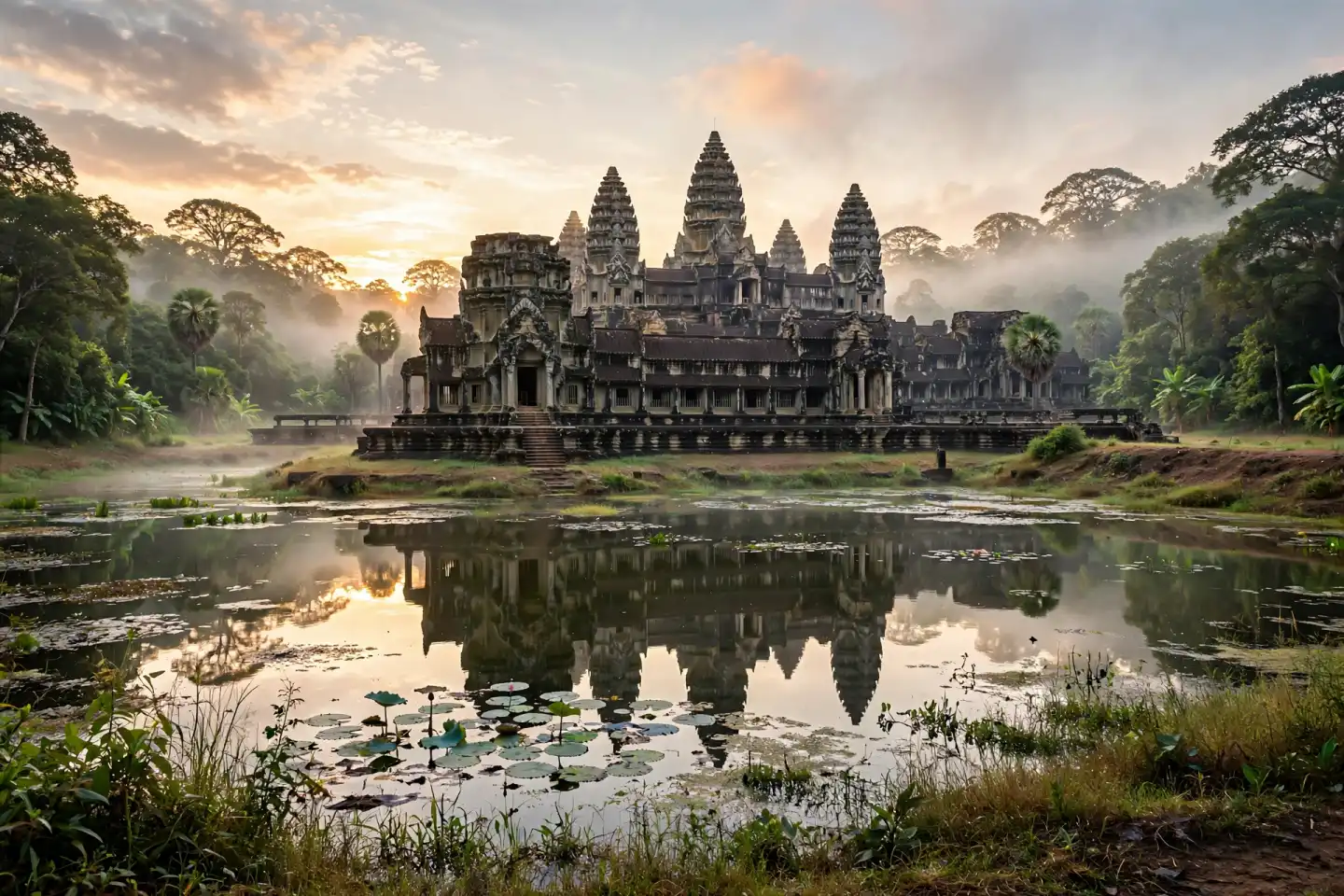
Siem Reap and the Angkor temples are best from November to February. Highs of about 31–32°C are hot but manageable, especially if you start at dawn. Angkor Archaeological Park opens at 05:00 and closes at 18:30, according to the official ticketing site, which makes early starts easy.
Phnom Penh follows a similar pattern. The capital averages 3–29 mm of rain a month from December to February, with highs of 30–33°C. From September to October it averages 242–253 mm, and the FCDO warns that poor drainage floods roads and causes major traffic delays, including on the route to the airport.
The south coast is wetter than the interior. Sihanoukville averages 27–41 mm of rain a month from December to February, but 487–617 mm a month from June to September. Kampot is drier in the dry season, at 21–29 mm, and peaks at 381 mm in August.
The north-east, including the Mekong town of Stung Treng, is very dry from December to February at 2–20 mm a month, and wet from July to September at 300–333 mm. The FCDO says monsoon storms can damage the road network and that landslides can seriously restrict travel to some provinces.
Cambodia's regions compared
Monthly averages from Cambodia's Ministry of Water Resources and Meteorology (via WMO), 1982–2024.
-
Siem Reap and Angkor
- Best months
- Nov–Feb
- Why
- Dry (4–62 mm) with highs of 30.7–32.3°C.
- What to avoid
- Apr–May heat (35°C highs); Sep–Oct rain of 227–305 mm.
-
Phnom Penh
- Best months
- Dec–Feb
- Why
- Dry (3–29 mm) with highs of 30–33°C.
- What to avoid
- Sep–Oct (242–253 mm); flooded roads, including to the airport.
-
Tonle Sap lake
- Best months
- Sep–Dec for high water
- Why
- The lake can grow up to five times larger as the Mekong overflows.
- What to avoid
- Late dry season, when low water and sandbars make boat travel difficult.
-
South coast (Sihanoukville, Kampot)
- Best months
- Dec–Feb
- Why
- Sihanoukville averages 27–41 mm a month and Kampot 21–29 mm.
- What to avoid
- Jun–Sep: 487–617 mm a month at Sihanoukville; boats may run despite warnings.
-
The north-east and the Mekong (Stung Treng)
- Best months
- Dec–Feb
- Why
- Very dry, at 2–20 mm a month.
- What to avoid
- Jul–Sep (300–333 mm), when roads in remote provinces can be cut.
Worst time to visit Cambodia, and why
The hardest times to visit Cambodia are April and May for heat, and September and October for rain.
Siem Reap averages highs of 34.8°C in April and 35.3°C in May, with lows of around 24–25°C, so nights give little relief. Temple days are possible but tiring, and you would need to see Angkor at dawn and rest in the afternoon.
September and October are the wettest months inland. Siem Reap averages 305 mm of rain in September and 227 mm in October; Phnom Penh averages 253 mm and 242 mm. The FCDO says heavy storms during this season disrupt and damage the road network, landslides can restrict travel to some provinces, and lakes, caves and waterfalls are prone to dangerous flash flooding.
That said, the wet season is not all bad. The countryside is green after the rains begin, and Angkor is far quieter than in December or January. If you choose June to October, keep your plans flexible, allow extra time on the roads and stay close to Siem Reap and Phnom Penh rather than remote provinces.
The peak season has its own downside: December and January are the busiest months at the main temples, especially over Christmas and New Year.
The wet season, flooding and river safety
Cambodia's wet season brings most of the year's rain between June and October. The FCDO says heavy storms in the monsoon season disrupt and damage the road network, and that travel to some provinces can be seriously restricted by landslides.
Flooding is the main hazard. The FCDO notes that lakes, caves and waterfalls are particularly prone to dangerous flash floods during the rainy season, and that poor drainage floods roads in Phnom Penh. River and lake water levels are high from June to October, making currents faster and more dangerous.
The FCDO advises extra care with water-based activities, such as swimming, kayaking and rafting, in the rainy season from May to October. River currents can be extremely strong and there have been fatalities. Tourist boats sometimes operate despite weather warnings, particularly between Sihanoukville and the nearby islands.
The dry season has its own river issue. The FCDO says boat travel on rivers is difficult from March to May because sandbars and other hazards are exposed.
On health, the FCDO lists malaria and dengue among the risks in Cambodia. Check vaccine and malaria advice at least 8 weeks before you travel, and take out travel insurance when you book.
The Tonle Sap: when to see the lake at its best
The Tonle Sap, the great lake south of Siem Reap, changes size with the seasons. UNESCO, which lists the area as a biosphere reserve, says the Mekong River overflows during the rains and can expand the lake by up to five times.
The Mekong River Commission says the flood season in the Mekong basin lasts from June to November. That means the lake is fullest towards the end of the wet season and into the early dry season, roughly September to December, when floating villages and flooded forest are surrounded by water.
As the dry season goes on, water levels drop. The FCDO says river travel is difficult from March to May because of exposed sandbars.
The official Angkor ticketing site also sells tickets for boat trips at Chong Kneas, the floating village closest to Siem Reap.
For most visitors, a November to January trip is the best compromise: the lake is still high after the rains, the weather on land is dry, and you can combine a boat trip with several days at Angkor. If you travel in April or May, check with a local operator which villages can be reached by boat.
Festivals and events in Cambodia
Cambodia's biggest national festivals, including Khmer New Year, the Water Festival and Pchum Ben, are worth knowing about because they affect travel, closures and crowds. Their dates are set each year, and we could not confirm 2027 dates from an official Cambodian source at the time of writing, so ask us for confirmed dates when you enquire.
The natural calendar is easier to plan around. The Mekong flood season runs from June to November, according to the Mekong River Commission, and the Tonle Sap swells to up to five times its dry-season size.
At Angkor, the main daily event is sunrise. The park opens at 05:00, according to the official ticketing site, and the dry-season months from November to February usually give the clearest mornings, with Siem Reap averaging just 4–62 mm of rain a month.
Angkor passes are sold for 1 day, 3 days or 7 days. A 3-day pass can be used within 7 days of purchase and a 7-day pass within 30 days, which helps if you want to dodge a rainy or crowded day.
Remember the dress code: the FCDO says you may be refused entry to religious sites, including Angkor Wat, in skirts or shorts above the knee or with bare shoulders.
Planning a trip to Cambodia from the UK
There are no nonstop flights from the UK to Cambodia. Heathrow's departures board on 12 Oct 2026 listed no nonstop services to Phnom Penh or Siem Reap, so plan on at least one connection.
The main international gateways are Phnom Penh, Siem Reap and Sihanoukville, the three airports the FCDO lists for Cambodia's electronic arrival card. A typical first trip combines Phnom Penh, the Tonle Sap and Angkor.
Cambodia is 7 hours ahead of the UK in winter and 6 hours ahead during British Summer Time. Cambodia does not change its clocks.
Cambodia's currency is the riel (KHR), and the National Bank of Cambodia publishes an official riel–US dollar rate. US dollars are also in use: the FCDO says visa-on-arrival fees are paid in US dollars.
UK school holidays fit the dry season well. The Christmas break and February half term both fall in the best months, which is why late December is so busy. The Easter holidays fall in the hot season, and the summer holidays fall in the wet season, when Angkor is quiet but rain is frequent. School holiday dates vary by council, so check your local authority's dates.
Do I need a visa for Cambodia from the UK?
Yes. The FCDO says you must have a visa to enter Cambodia as a visitor, and tourist visas are valid for 30 days from the date of entry.
You can apply for an e-visa online at least 4 days before you travel, or through the official e-visa app on iOS or Android. If you do not get an e-visa, you can get a visa on arrival at airports and land border crossings; you need a photo and must pay in US dollars. Tourist visas can be extended once you are in Cambodia.
Your passport should be valid for at least 6 months from the date you arrive and must be undamaged, as entry is normally refused with a damaged passport or missing pages.
Since 1 September 2024, travellers arriving by air at Phnom Penh, Siem Reap or Sihanoukville must complete an electronic e-Arrival Card within 7 days before arrival. The FCDO says there is no charge for this.
The FCDO also warns that unofficial fees are sometimes requested or visa prices inflated at land borders, so know the correct requirements before you travel. Overstaying can lead to fines, detention and deportation.
Entry rules change, so check the live FCDO travel advice page for Cambodia before you book and again before you fly.
Frequently asked questions
November is arguably the best single month to visit Cambodia. The rains have eased to an average of 62 mm in Siem Reap, highs are around 31.6°C, the countryside is green and the Tonle Sap is still high. December and January are drier but much busier.
Cambodia's rainy season runs from about June to October. The FCDO says heavy monsoon storms in those months disrupt and damage the road network. Siem Reap's wettest month is September, averaging 305 mm of rain, followed by October at 227 mm.
Yes, if you are flexible. The temples at Angkor are quieter than in peak season and the landscape is green. The downsides are flooding, damaged roads and dangerous river currents, which the FCDO highlights for June to October. Stay close to the main towns.
November to February is the best time to visit Angkor Wat. Siem Reap averages highs of 30.7–32.3°C and very little rain. The park opens at 05:00, so dawn visits beat the heat. April and May are the hottest months, with highs of around 35°C.
April and May are the hottest months in Cambodia. Siem Reap averages highs of 34.8°C in April and 35.3°C in May, with night-time lows of about 24–25°C. Phnom Penh averages 34.9°C in April. Plan temple visits for early morning in these months.
September to December is the best time to see the Tonle Sap at high water. UNESCO says the lake can expand up to five times as the Mekong overflows, and the Mekong River Commission puts the flood season at June to November. From March to May, low water makes boat travel difficult.
No. There are no nonstop flights from the UK to Cambodia, and Heathrow's departures on 12 Oct 2026 listed none to Phnom Penh or Siem Reap. You will need at least one connection, so allow for a longer total journey time.
Yes. The FCDO says British visitors need a visa, which you can get as an e-visa at least 4 days ahead or on arrival, paid in US dollars. Tourist visas last 30 days. Air arrivals must also complete a free e-Arrival Card within 7 days before landing.
Cover your shoulders and knees. The FCDO says you may be refused entry to religious sites, including Angkor Wat, if you wear skirts or shorts above the knee, and advises covering bare shoulders. Light, loose clothing and a hat help in temperatures above 30°C.