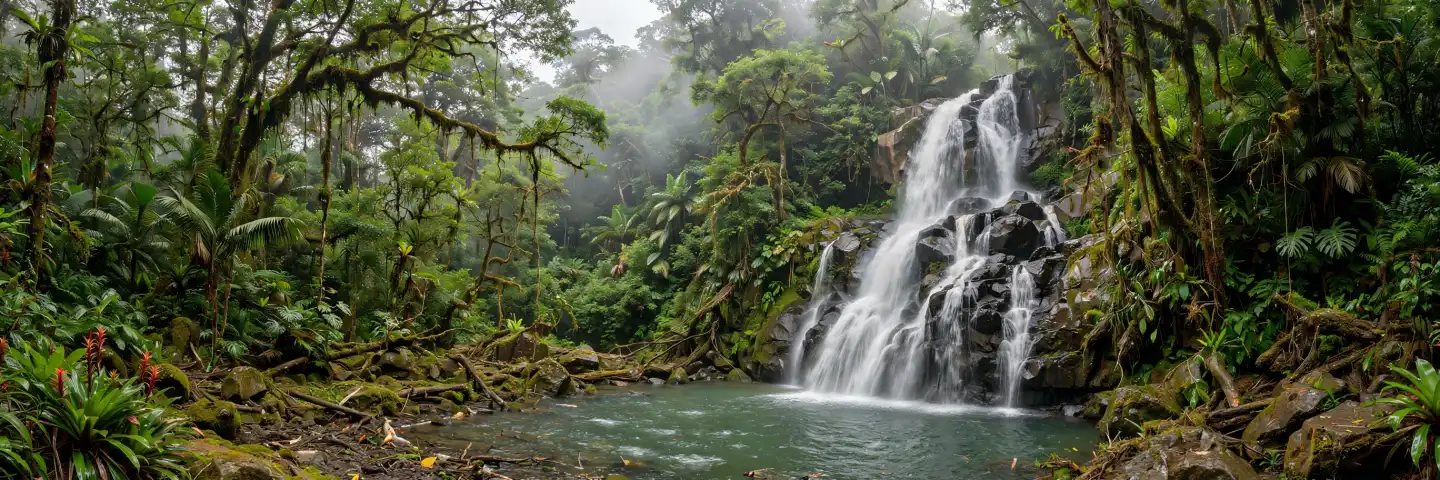






The best time to visit Costa Rica is the dry season from December to April, when the Pacific coast and Guanacaste get almost no rain. The trade-off is peak demand. September and October are the wettest months on the Pacific side, but they are one of the Caribbean coast's two relatively dry spells.
Month by month
| Month | High | Low | Rain | What to expect |
|---|---|---|---|---|
| January Best | 23°C | 15°C | 9 mm | Peak dry season across the Pacific side; sunny days and busy beaches. |
| February Best | 24°C | 15°C | 5 mm | Driest month in San José; also a relatively dry spell on the Caribbean coast. |
| March Best | 25°C | 16°C | 12 mm | Driest and hottest month on the Pacific coast; Easter demand often falls here or in April. |
| April Best | 26°C | 16°C | 44 mm | Transition month: still mostly dry, with the first showers late in the month. |
| May | 26°C | 17°C | 222 mm | Green season starts; mornings often bright, rain in the afternoon. |
| June | 26°C | 17°C | 283 mm | Wet and green; quiet parks and lush forest. |
| July | 25°C | 16°C | 208 mm | Pacific 'veranillo' lull in the rain, and a Caribbean rain peak; UK summer holidays begin. |
| August | 25°C | 17°C | 252 mm | Veranillo continues on the Pacific; turtle nesting under way at Tortuguero. |
| September | 26°C | 17°C | 325 mm | Among the wettest Pacific months; the Caribbean coast enters a relatively dry spell. |
| October | 25°C | 16°C | 326 mm | Wettest month in San José; Carnaval del Limón on the Caribbean coast. |
| November | 24°C | 16°C | 139 mm | Transition back to dry on the Pacific; the Caribbean's wettest period begins. |
| December Best | 23°C | 16°C | 40 mm | Dry season returns to the Pacific; Christmas peak. Rainiest month on the Caribbean coast. |
Costa Rica's dry season and green season explained
Costa Rica has two seasons: a dry season and a rainy season that the tourism board calls the green season. The Costa Rica Tourism Board (ICT) compares regional activities across a dry season from December to April and a green season from May to November.
The mountain spine running north-west to south-east splits the country in two, and each side has its own rain pattern. On the Pacific side, the ICT says the dry season lasts from December to March, April is a transition month and March is the driest and hottest month. The rains run from May to October, with November as a transition, and the heaviest falls in September and October.
Temperature depends more on altitude than on month. National met service averages for San José, in the Central Valley, show highs of 23–26°C all year, while Liberia in lowland Guanacaste reaches 33–36°C in the dry season.
Green-season rain has a rhythm. On the Pacific side, the ICT says rain mainly falls in the afternoon and early evening, so mornings are often usable for hikes and wildlife trips. For a classic first visit mixing beach and rainforest, December to April is the safest window.
Best time to visit Costa Rica by trip type
Best months by trip type, based on Costa Rica Tourism Board (ICT) climate guidance and national met service averages published by the WMO.
-
Pacific beaches (Guanacaste, Nicoya)
- Best months
- Dec–Apr
- Why
- Liberia averages 1–18 mm of rain a month from January to April; March is the driest, hottest Pacific month.
-
Caribbean beaches (Puerto Viejo, Cahuita)
- Best months
- Feb–Mar, Sep–Oct
- Why
- The ICT identifies these as the Caribbean coast's two relatively dry periods.
-
Turtle nesting
- Best months
- Mar–Oct (Tortuguero)
- Why
- The ICT calls Tortuguero the country's most important nesting site, especially March to October.
-
Rainforest and wildlife
- Best months
- Dec–Apr for easier trails; May–Nov for green landscapes
- Why
- Dry-season trails are easier; the ICT lists Corcovado hiking and Tortuguero turtles among green-season highlights.
-
Whale and dolphin watching
- Best months
- May–Nov
- Why
- The ICT lists whale and dolphin watching at Ballena National Marine Park as a green-season activity.
-
Avoiding crowds
- Best months
- May–Jun, Sep–Oct
- Why
- Green-season months fall outside the dry-season, Christmas and Easter peaks.
-
UK school holidays
- Best months
- Feb half-term, Easter
- Why
- Both fall in the dry season; the summer break coincides with the Pacific veranillo in July and August.
Pacific coast vs Caribbean coast: when to go
The two coasts of Costa Rica peak at different times, which is useful if you can only travel in certain months.
The Pacific coast, including Guanacaste, the Nicoya Peninsula, Manuel Antonio and the Osa Peninsula, has a well-defined dry season. National met service averages for Liberia show just 1–5 mm of rain a month from January to March, rising to 362 mm in September. Quepos, near Manuel Antonio, follows the same pattern but is wetter overall, with 544 mm in September.
The Caribbean coast works differently. The ICT says it has no well-defined dry season, with even the driest months seeing 100–200 mm of rain. It has two relatively dry periods, February to March and September to October, and its heaviest rain from November to January, with December the rainiest month. Averages for Limón confirm this: 146 mm in September against 449 mm in December. Rain there falls mostly at night and in the morning.
In practice, this means September and October, the worst months for the Pacific, are the best months for Tortuguero, Cahuita and Puerto Viejo. If your dates are fixed in autumn, plan your trip around the Caribbean side.
Costa Rica's regions compared: when to go
Rainfall figures are national met service monthly averages published by the WMO for one station in each region.
-
Guanacaste and north Pacific (Liberia)
- Best months
- Dec–Apr
- Why
- Near-zero rain January to March (1–5 mm a month at Liberia); highs of 33–36°C.
- What to avoid
- September and October, when Liberia averages 362 mm and 317 mm.
-
Central Pacific (Quepos, Manuel Antonio)
- Best months
- Dec–Mar
- Why
- Quepos averages 26–46 mm a month from January to March.
- What to avoid
- September and October, with 544 mm and 534 mm at Quepos.
-
South Pacific (Osa, Corcovado, Uvita)
- Best months
- Dec–Apr for beaches; May–Nov for whales
- Why
- The ICT lists whale watching at Ballena and Corcovado hiking among green-season highlights.
- What to avoid
- Peak rain: the ICT calls the region one of the wettest areas in Costa Rica.
-
Caribbean (Tortuguero, Limón, Puerto Viejo)
- Best months
- Feb–Mar, Sep–Oct; Mar–Oct for turtles
- Why
- Limón's driest month is September (146 mm); Tortuguero nesting peaks March to October.
- What to avoid
- December and July, Limón's wettest months (449 mm and 439 mm).
-
Central Valley (San José)
- Best months
- Dec–Apr
- Why
- San José averages 5–44 mm a month from January to April, with highs of 23–26°C.
- What to avoid
- September and October, when San José averages about 325 mm a month.
Best time to see turtles and wildlife in Costa Rica
Costa Rica's wildlife is there all year, but some of the biggest spectacles are seasonal.
Turtle nesting is the headline event. The ICT describes Tortuguero National Park, on the northern Caribbean coast, as the most important place for nesting sea turtles in the country, especially between March and October. It also names the green turtle nesting beaches of Tortuguero and the Barra del Colorado National Wildlife Refuge. The ICT notes that Tortuguero can only be reached by boat or plane.
On the Pacific side, the ICT names Las Baulas National Marine Park as a place to see egg-laying turtles, and lists turtle observation at Ostional National Wildlife Refuge in Guanacaste among activities in both the dry and green seasons. Go with a licensed local guide.
For whales, the ICT lists whale and dolphin watching at Ballena National Marine Park, near Uvita, as a green-season activity, alongside hiking in Corcovado National Park and turtle watching on the Osa Peninsula.
The ICT also notes that more than 900 bird species visit or live in Costa Rica, so birdwatching works in any month.
Is it worth going to Costa Rica in the green (rainy) season?
Yes, if you plan around the rain. The green season from May to November is quieter and greener, and some of Costa Rica's best wildlife experiences happen then.
The pattern of the rain matters more than the totals. On the Pacific side, the ICT says rain falls mainly in the afternoon and early evening, so an early start gives you the best of the day. It also describes a lull in July and August called the veranillo, or 'little summer', when the trade winds strengthen and rainfall drops. That lull suits UK families travelling in the summer holidays.
The ICT's green-season list includes white-water rafting on the Pacuare and Savegre rivers, kayaking in Ballena National Marine Park, hiking in Corcovado and Monteverde, and turtle watching at Tortuguero.
The catch is September and October on the Pacific side, when the ICT says the rains peak. The FCDO adds that June to November is the peak rainy season, with flooding and landslides that may close roads. If you travel then, base yourself on the Caribbean coast and keep driving days short.
The worst time to visit Costa Rica, and why
For most UK travellers, September and October are the worst months to visit Costa Rica's Pacific coast and Central Valley. National met service averages show 325–326 mm of rain a month in San José, 544 mm in September at Quepos and 362 mm at Liberia. The ICT calls these the rainiest months on the Pacific side, and the FCDO warns that flooding and landslides can close roads during the rainy season.
That does not make the whole country a write-off. The same two months are one of the Caribbean coast's relatively dry periods, according to the ICT, so Tortuguero and Puerto Viejo can be a sound choice.
The other 'worst time' is about crowds rather than weather. The dry season from December to April is the busiest period, and Christmas, New Year and Easter are the most in-demand weeks. Expect to book well ahead for popular parks and beach hotels.
On the Caribbean coast itself, December is the weakest month: the ICT names it as the rainiest month, influenced by cold fronts from the north. If you want both coasts in one trip, February to March is the only window when both are relatively dry.
Weather hazards: hurricanes, flooding, volcanoes and rip currents
Costa Rica is not immune to tropical storms. The FCDO says Costa Rica's hurricane season usually runs from June to November, the same as the Caribbean, and advises monitoring NOAA hurricane forecasts. NOAA states that the Atlantic season officially runs from 1 June to 30 November, with most activity between mid-August and mid-October.
Flooding is the more common problem. The FCDO says June to November is also the peak rainy season, when flooding and landslides may cause road closures, and that heavy rains can cause potholes and landslides that block roads.
Volcanoes are part of the landscape. The FCDO notes that Costa Rica has 16 volcanoes, several considered active, and reports a significant series of eruptions at Poás Volcano. Check local advice before visiting any volcano area and avoid them during and just after heavy rain.
The sea is the biggest everyday risk. The FCDO warns that rip currents are very common, lifeguards are often absent, and drownings average 50 to 60 a year, a third of them tourists. It also reports regular crocodile sightings along the Pacific coast between Playa Azul and Playa Esterillos.
Festivals and events in Costa Rica by month
Costa Rica's events calendar is a good tie-breaker when choosing a month. The ICT lists these as regular fixtures; check exact dates each year before you book.
In January, the Fiestas de Palmares bring rodeos, horse parades and music to Palmares. The Indigenous community of Rey Curré also stages its Juego de los Diablitos, the 'Little Devils Game', commemorating resistance to the Spanish conquest.
In February, the Envision Festival takes place in Uvita on the South Pacific coast, with healing ceremonies, dance parties and celebrations.
In October, the Carnaval del Limón fills the Caribbean port city during the second full week of the month, with costumes, floats and Afro-Caribbean food and music. It coincides with one of the Caribbean coast's relatively dry spells.
In December, Boruca holds its own Juego de los Diablitos, and the Fiestas de Zapote rodeo and fair runs in San José at the end of the month.
The National Symphony Orchestra's season at the National Theatre in San José runs from February to November, according to the ICT.
Planning a trip to Costa Rica from the UK
There is a nonstop flight from London to Costa Rica. The ICT and airport operator Aeris reported that British Airways is moving its route from Gatwick to Heathrow, with five flights a week from late October 2026 to March 2027 and three a week from April to September 2027. The published winter schedule leaves Heathrow at 11:10 and lands in San José at 16:40 local time, roughly 11 hours 30 minutes in the air. The main gateways are Juan Santamaría International Airport (SJO) near San José and Daniel Oduber Quirós International Airport (LIR) in Liberia, for Guanacaste.
Costa Rica is 6 hours behind the UK in winter and 7 hours behind during British Summer Time, as it does not use daylight saving, according to the IANA time zone database.
UK school holidays matter. February half-term and Easter fall in the busy dry season, while the summer break coincides with the Pacific veranillo. Check your council's term dates on GOV.UK.
The FCDO says British visitors can enter Costa Rica without a visa for up to 180 days, at the immigration officer's discretion. Read the live FCDO page before you travel.
Frequently asked questions
February is the best single month for most first-time visitors. It falls in the Pacific dry season, San José averages just 5 mm of rain, and the ICT lists February to March as a relatively dry spell on the Caribbean coast too. That makes it the one month when both coasts usually work in a single trip.
Costa Rica's rainy, or green, season runs from May to November on the Pacific side. The ICT says rain peaks in September and October and usually falls in the afternoon and early evening. July and August bring a lull called the veranillo. The Caribbean coast follows a different pattern, with December its rainiest month.
The green-season months, especially May, June, September and October, are usually the best value because demand is lowest outside the December to April dry season. September and October are the wettest on the Pacific side, so pair them with the Caribbean coast. Prices change with availability, so compare live options for your dates.
Turtle nesting at Tortuguero National Park on the Caribbean coast is busiest between March and October, according to the Costa Rica Tourism Board, which calls it the country's most important nesting site. On the Pacific coast, the ICT lists turtle observation at Ostional and Las Baulas. Always watch nesting turtles with a licensed local guide.
Yes, for wildlife lovers who plan around the rain. Mornings are often dry on the Pacific side, the forests are at their greenest and the ICT lists turtle watching, whale watching at Ballena and rafting among green-season highlights. Avoid long Pacific road journeys in September and October, when the FCDO warns of flooding and landslides.
March and April are the hottest months in Costa Rica's lowlands. The ICT names March as the driest and hottest month on the Pacific side, and national met service averages for Liberia in Guanacaste show highs of 35°C in March and 36°C in April. The Central Valley stays mild, with San José averaging 23–26°C.
February to March and September to October are the best times for the Caribbean coast. The ICT identifies these as the coast's two relatively dry periods, and Limón's averages fall to 146 mm in September. Turtle nesting at Tortuguero is also under way from March to October. December is the rainiest month there.
Yes. British Airways flies nonstop from London to San José (SJO). From late October 2026 the route moves from Gatwick to Heathrow, with five flights a week until March 2027, according to the Costa Rica Tourism Board and airport operator. The winter schedule implies about 11 hours 30 minutes outbound.
Yes, Costa Rica can be affected by tropical weather. The FCDO says the hurricane season usually runs from June to November, the same as the Caribbean, and that the same period is the peak rainy season, when landslides may close roads. Watch forecasts and buy travel insurance early.