

The best time to visit Iceland is June to August for near-endless daylight, open Highland roads and whale watching, or September to April for the Northern Lights. September gives you a fair chance of both. The trade-off: summer is the busiest and dearest season, while winter brings short days, storms and closed mountain roads.
Month by month
| Month | High | Low | Rain | Crowds | What to expect |
|---|---|---|---|---|---|
| January | 2°C | -3°C | 76 mm | Low | Deep winter: a few hours of daylight, frequent snow and storms, good dark skies for the aurora when it clears. |
| February | 3°C | -2°C | 72 mm | Medium | Still winter, with lengthening days; aurora season continues and UK February half term adds some demand. |
| March Best | 3°C | -2°C | 82 mm | Medium | Equinox month, when aurora activity is said to peak; wet, windy and changeable, with snow still likely. |
| April | 6°C | 0°C | 58 mm | Medium | Daylight jumps from about 13 to 16 hours; whale-watching season starts and the aurora gets harder to see. |
| May | 9°C | 4°C | 44 mm | Medium | Driest month in the Reykjavík averages; puffins arrive and midnight-sun nights begin mid-month, but the Highlands stay closed. |
| June Best | 12°C | 7°C | 50 mm | High | Peak midnight sun with 20–21 hours of daylight in Reykjavík; the first Highland roads open; busy and expensive. |
| July Best | 13°C | 8°C | 52 mm | High | Warmest month; most Highland routes are open by mid-July. One of the two busiest months of the year. |
| August Best | 13°C | 8°C | 62 mm | High | Busiest month on record for departures; daylight falls to about 14.5 hours and the aurora can return late in the month. |
| September Best | 10°C | 5°C | 66 mm | High | Autumn colours, sheep round-ups and dark nights for the aurora; Highland roads start closing mid-month. |
| October Best | 7°C | 2°C | 86 mm | Medium | Wettest month in the Reykjavík averages; daylight drops from 11–12 hours to about eight. Good aurora odds when it clears. |
| November | 3°C | -1°C | 72 mm | Low | Short, stormy days and long nights; one of the quietest months for visitors. |
| December | 2°C | -3°C | 79 mm | Low | Darkest month, with about four hours of daylight at the solstice; Yuletide festivities and the fewest visitors of the year. |
Best time to visit Iceland by trip type
Pick your months by what you want to do. Sources: Visit Iceland, the Icelandic Road and Coastal Administration and the Icelandic Tourist Board.
-
Northern Lights
- Best months
- Sep–Apr (equinoxes in Sep and Mar)
- Why
- Dark nights are needed; activity is said to be strongest around the equinoxes, and midwinter gives the longest dark window.
-
Midnight sun and long days
- Best months
- Mid-May–mid-Jul
- Why
- The sun barely sets; Reykjavík gets around 20–21 hours of daylight in June.
-
Whale watching
- Best months
- Apr–Sep
- Why
- Visit Iceland's main season; tours run from Reykjavík's Old Harbour and Húsavík in the north.
-
Puffins
- Best months
- May–mid-Aug
- Why
- Puffins nest on sea cliffs from early May and leave around mid-August.
-
Highlands and hiking (Landmannalaugar, Laugavegur)
- Best months
- Late Jun/Jul–early Sep
- Why
- Most F-roads open between late May and mid-July and are usually closed from mid-September.
-
Ring Road self-drive
- Best months
- Jun–Aug
- Why
- Longest days and fewest storm closures; book cars early as summer is the busiest season.
-
Avoiding crowds
- Best months
- Nov–Jan
- Why
- The lowest foreign departure numbers from Keflavík in 2025, though days are short.
-
Better-value travel
- Best months
- Apr–May, Sep–Oct
- Why
- Visit Iceland says the shoulder seasons are a chance for better airfares and more choice of rooms.
-
UK school holidays
- Best months
- Feb half term, Easter, summer holidays
- Why
- February and Easter fall inside aurora season; the summer holidays coincide with Iceland's peak, so book well ahead.
Iceland's seasons explained
Iceland has a short summer, a long winter and quick, unpredictable shoulder seasons in between. Visit Iceland puts the travel summer at June to August, and notes that winter can arrive as early as September while summer can hold off until July.
The climate is milder than the name suggests. A branch of the Gulf current warms the south and west coasts, so Icelandic Met Office averages for Reykjavík show winter highs of around 2–3°C and summer highs of about 13°C. The catch is the weather's mood swings: milder Atlantic air meets Arctic air, which brings frequent storms, wind and sudden change at any time of year.
Rain is spread through the year. In the Reykjavík averages, May is the driest month at about 44 mm and October the wettest at about 86 mm. The north is colder in winter but often warmer in summer than the south, and the Highlands above 200–400 m are usually snow-covered from September until May.
In practice, most UK travellers choose between two Icelands. Summer is for road trips, hiking, puffins and light that lasts all night. Winter, from roughly September to April, is for the Northern Lights, ice and snow, with far fewer visitors and much shorter days.
When is the best time to see the Northern Lights in Iceland?
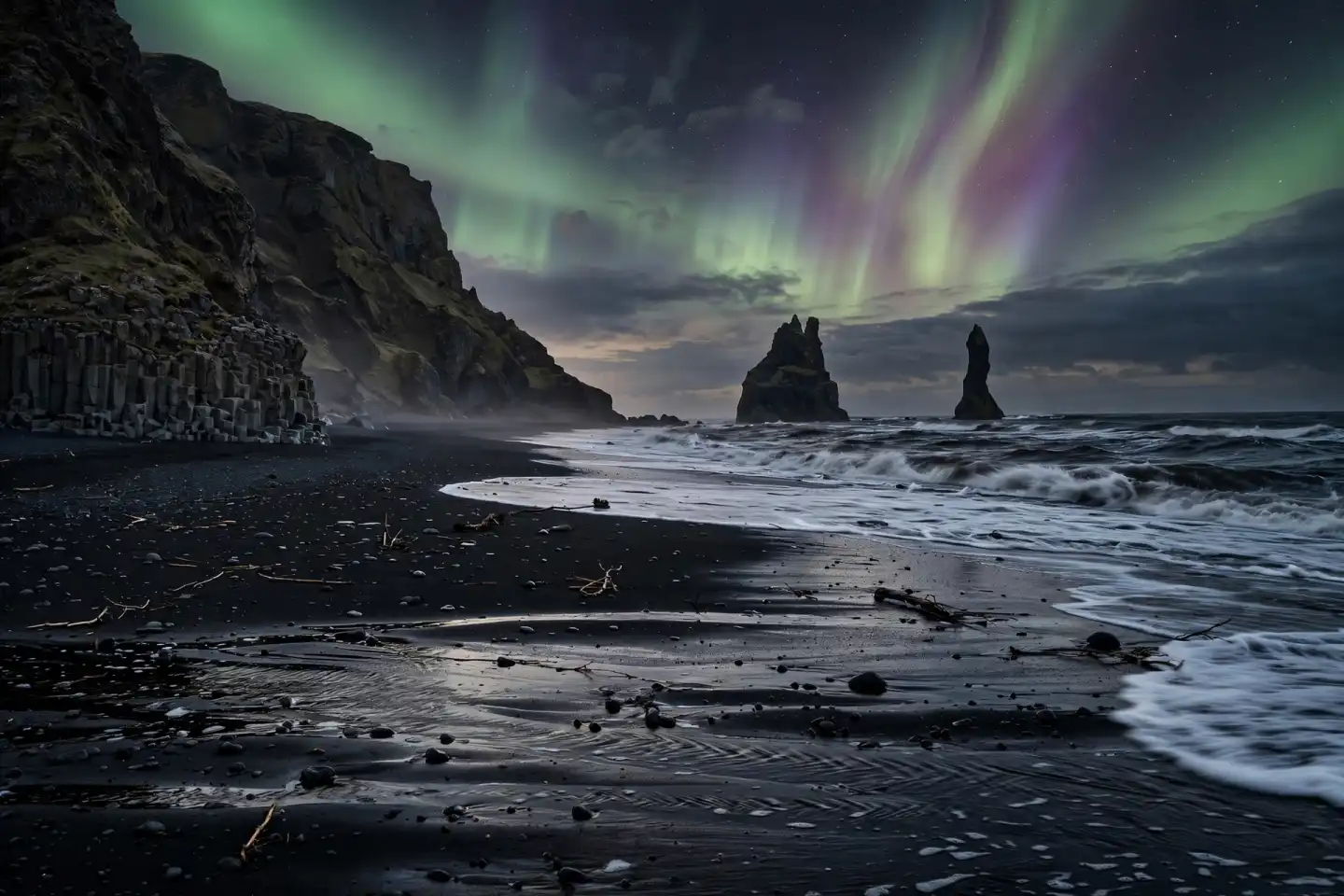
The best time to see the Northern Lights in Iceland is September to April, when the nights are long and dark enough. Visit Iceland says activity is often strongest around the equinoxes in September and March, while midwinter gives you the longest dark window each night. By late August the skies are already dark enough for the aurora to return.
Darkness is only half of it. The Icelandic Met Office says the aurora needs dark and at least partly clear skies, so cloud is the usual spoiler. Its aurora forecast, which shows predicted activity and cloud cover, is the tool to check each evening. Plan several nights rather than one, and stay flexible about where you drive.
You can see the lights from Reykjavík on a clear, active night, but your chances improve away from city lights. Visit Iceland suggests Öskjuhlíð and Grótta in the city, or darker spots such as Þingvellir National Park and Kleifarvatn. North Iceland, around Lake Mývatn, is another option.
No month guarantees a sighting. If the aurora is the main reason for your trip, February, March, September and October balance dark nights with more daylight for sightseeing than December and January.
Midnight sun and daylight hours in Iceland by month
Iceland's midnight sun runs from about mid-May to mid-July. In June, Visit Iceland says Reykjavík gets around 20–21 hours of daylight, Akureyri in the north nearly 23.5 hours, and the island of Grímsey, which sits on the Arctic Circle, has perpetual daylight. The sky never gets properly dark, which is wonderful for late-evening sightseeing and hopeless for the aurora.
Daylight then shrinks quickly. July still has about 18–20 hours a day. August starts with around 18 hours and ends with about 14.5. In October, Reykjavík goes from 11–12 hours of daylight at the start of the month to roughly eight by the end, with sunrise after 09:00.
Midwinter is the opposite. Visit Iceland says the sun only clears the horizon for about four hours around the winter solstice in December. Days lengthen fast again in spring: by April, Reykjavík has about 13 hours of daylight at the start of the month and 16 by the end.
For a first trip, the daylight question often decides the month. Long days suit a self-drive Ring Road trip; short days suit a city break with aurora excursions.
Best time for whale watching and puffins in Iceland
The best time for whale watching in Iceland is April to September, according to Visit Iceland. Tours run less often in winter, but they still operate. The species most often seen are humpback whales, minke whales, orcas, fin whales and sperm whales.
Tours leave from the Old Harbour in Reykjavík every day in season. Húsavík, in North Iceland, is the town that pioneered whale watching, and Visit Iceland says the nutrient-rich northern waters draw humpbacks, minkes and the occasional blue whale. Calm summer seas make for easier crossings, and some operators run late-evening trips under the midnight sun.
Puffins arrive at the beginning of May to nest on sea cliffs and stay until about mid-August. Visit Iceland names colonies along the South Coast, in the Westfjords and at Hafnarhólmi in Borgarfjörður Eystri in East Iceland, where boardwalks let you watch without disturbing the birds.
If wildlife is the priority, June and July give you whales and puffins together, plus the longest days. Late May and early September are quieter alternatives, although by September the puffins have gone.
When do the Highland roads (F-roads) open in Iceland?
Iceland's Highland roads, marked with an F, open in stages between late May and mid-July and are usually closed again from mid-September. The Icelandic Road and Coastal Administration says snow cover is the main factor in when each mountain road can open. Where a road crosses a conservation area, it can stay shut until the land can cope with visitors, even after the snow has gone.
The Administration's records for 2021–2025 show how much the dates vary. The Kjölur route (35) from Gullfoss to Hveravellir opened on average on 1 June. The road to Landmannalaugar via Sigalda (F208) averaged 2 June. Sprengisandur (F26) averaged 6 July, and some routes have opened as late as 15 July.
Safetravel, run by Iceland's search and rescue association, says F-roads are usually closed from mid-September until June or July. A 4x4 is needed on F-roads, and Safetravel warns that no insurance covers damage to a vehicle while crossing a river.
For a Highland trip, such as hiking the Laugavegur trail between Landmannalaugar and Þórsmörk, aim for July to early September. Check the live road map on road.is, which now redirects to umferdin.is, before setting off.
When Iceland's main Highland roads open
Opening dates recorded by the Icelandic Road and Coastal Administration for 2021–2025. Dates depend on snow and change every year: check road.is (now umferdin.is) before you travel.
-
Kjölur (35), Gullfoss–Hveravellir
- Earliest opening
- 30 May
- Latest opening
- 14 Jun
- Average opening
- 1 Jun
-
Fjallabaksleið North (F208), Sigalda–Landmannalaugar
- Earliest opening
- 23 May
- Latest opening
- 23 Jun
- Average opening
- 2 Jun
-
Landmannaleið (F225), Dómadalur
- Earliest opening
- 9 Jun
- Latest opening
- 24 Jun
- Average opening
- 16 Jun
-
Lakagígar (F206)
- Earliest opening
- 12 Jun
- Latest opening
- 1 Jul
- Average opening
- 20 Jun
-
Sprengisandur (F26), Hrauneyjar–Nýidalur
- Earliest opening
- 21 Jun
- Latest opening
- 13 Jul
- Average opening
- 6 Jul
Worst time to visit Iceland, and why
There is no single bad month, but each season has a clear downside. For a self-drive road trip, December and January are the hardest months. Visit Iceland says the sun is up for only about four hours around the solstice, storms are frequent, and snow and ice can close roads at short notice. The Highlands are shut, and some countryside campsites, museums and restaurants close outside summer.
For the Northern Lights, the worst time is mid-May to mid-July. The midnight sun means it never gets properly dark, so the aurora cannot be seen however active it is.
If you dislike crowds or high prices, July and August are the months to avoid. The Icelandic Tourist Board counted about 302,000 foreign departures from Keflavík in July 2025 and 313,000 in August, more than double January's 122,000. Visit Iceland notes that flights, accommodation and rental cars cost more, and can sell out, in summer, and that the busiest sights on the South Coast see up to a thousand visitors a day.
October can disappoint those expecting crisp autumn days: it is the wettest month in the Reykjavík averages, at about 86 mm.
Weather hazards: storms, winter driving and volcanic activity
Iceland's main hazard is fast-changing weather. Visit Iceland warns that storms with extreme winds, rain and snow are frequent and can arrive suddenly, so it advises packing for four seasons and keeping plans flexible. The FCDO notes that strong winds can throw sand or ash at cars and that conditions can quickly make driving difficult, so suitable tyres, including winter tyres when needed, matter.
In the lowlands, temperatures often swing either side of 0°C, which turns snow into ice. North Iceland and the Westfjords can get snow several metres deep. Check the Icelandic Met Office forecast and the Safetravel alerts every day, and register your travel plan with Safetravel if you are hiking or driving in remote areas.
Volcanic activity is the other risk to understand. The FCDO says a series of eruptions has affected the Reykjanes peninsula in south-west Iceland, including the town of Grindavík, since December 2023, while Reykjavík and Keflavík airport have not been affected. Gas near an eruption site can quickly reach dangerous levels, and you should never walk on new lava.
The FCDO also lists getting too close to the ocean, cliff edges and hot springs among common causes of accidents.
Festivals and events in Iceland by month
Iceland's calendar follows the light. In December, the Yuletide season is the biggest holiday of the year, with a month of festivities, food and the 13 Yule Lads, the mischievous figures of Icelandic folklore. Easter brings family skiing at resorts such as Bláfjöll near Reykjavík and Hlíðarfjall in Akureyri.
Summer is festival season. Visit Iceland lists National Day in June, the Siglufjörður Folk Music Festival in July, and Reykjavík Pride followed by Culture Night (Menningarnótt) in August, which ends with fireworks over the harbour. On Grímsey, a family Summer Solstice Festival is held around the June solstice.
Autumn has its own traditions. At the start of September, farmers gather sheep and horses from the mountains in the réttir round-ups, which visitors can watch and sometimes join. Berry picking usually starts between mid-August and mid-September, depending on the summer.
Exact dates change each year, so check the organiser's own page before you book. Big August events in Reykjavík can make accommodation in the city harder to find on those weekends.
Planning a trip to Iceland from the UK
Iceland is one of the closest long-weekend escapes from the UK. Keflavík Airport (KEF) lists nonstop flights of about 3h 15m from London Heathrow (Icelandair and British Airways), 3h 10m from Gatwick (Icelandair) and 3h 10m from Luton (easyJet), all year. From Manchester it is about 2h 45m–2h 50m (Icelandair and easyJet all year), and from Edinburgh about 2h 20m and Glasgow about 2h 15m. Bristol, Birmingham, Leeds, Newcastle and Stansted have winter-only routes. Akureyri, in the north, has seasonal direct flights from London and Manchester.
Iceland stays on GMT all year, so it shares UK time in winter and is one hour behind during British Summer Time. The currency is the Icelandic króna (ISK).
UK visitors made up 10.1% of foreign departures from Keflavík in 2025, the second-largest market after the USA. UK school holidays matter: February half term and Easter fall in aurora season, while the summer holidays land on Iceland's peak, so book early.
Iceland is in the Schengen area. The FCDO says British visitors can stay up to 90 days in any 180-day period without a visa, and that the EU's Entry/Exit System (EES) is being implemented, which means fingerprints and a photo on your first entry. The EU's ETIAS travel authorisation is not yet operating. Check the live FCDO page before you travel.
Frequently asked questions
September is the best all-round month for many travellers: long enough days for driving, dark nights for the Northern Lights, autumn colours and fewer visitors than August. For the midnight sun, wildlife and Highland roads, choose late June or July instead. For the Northern Lights alone, February and March balance dark nights with more daylight.
Demand is lowest from November to January, when Keflavík records the fewest foreign departures, so that is generally when you have the most choice. Visit Iceland also points to the shoulder seasons, spring and autumn, as a chance to find better airfares and more rooms. Summer is the most expensive and most heavily booked time.
The Northern Lights season in Iceland runs from September to April. Visit Iceland says activity is often strongest around the September and March equinoxes, while December and January give the longest hours of darkness. Clear skies matter as much as the month, so check the Icelandic Met Office aurora and cloud forecast each evening.
Yes, you can see the Northern Lights from Reykjavík on clear nights with strong aurora activity. City lights wash out fainter displays, so Visit Iceland suggests darker spots such as Grótta and Öskjuhlíð in the city, or Þingvellir National Park and Kleifarvatn a short drive away. Sightings are never guaranteed, so allow several nights.
The midnight sun in Iceland runs from about mid-May to mid-July. In June, Reykjavík gets around 20–21 hours of daylight, and Akureyri in the north nearly 23.5 hours. On Grímsey, which lies on the Arctic Circle, the sun barely touches the horizon between about 7 June and 7 July.
Iceland's F-roads open in stages between late May and mid-July, depending on snow, and usually close again from mid-September. Records for 2021–2025 show Kjölur opening on average on 1 June and Sprengisandur on 6 July. Always check the live map on road.is (umferdin.is) before you drive, and use a 4x4.
Yes, if you want the Northern Lights, snowy landscapes and fewer crowds. Winter also brings very short days, about four hours of daylight at the December solstice, frequent storms and closed Highland roads. A Reykjavík base with guided day trips is often easier than a long self-drive between November and February.
The best time for whale watching in Iceland is April to September. Tours run daily from Reykjavík's Old Harbour and from Húsavík in North Iceland, where humpbacks and minke whales are common and blue whales are occasionally seen. Winter tours do run, but less often and in rougher seas.
A nonstop flight from London to Keflavík takes about 3h 10m–3h 15m, according to Keflavík Airport's route listings for Heathrow, Gatwick and Luton. Flights from Manchester take about 2h 45m–2h 50m, from Edinburgh about 2h 20m and from Glasgow about 2h 15m. Some regional UK airports only fly in winter.
No. Iceland is in the Schengen area, and the FCDO says British passport holders can visit for up to 90 days in any 180-day period without a visa. Your passport must meet Schengen issue and expiry rules, and you may need to register fingerprints and a photo under the EU's Entry/Exit System. Check the live FCDO page.