


The best time to visit Norway is June to August for the fjords, hiking and the midnight sun, or late September to March for the Northern Lights in Tromsø and the Arctic north. June is the sweet spot for long days before the July peak. The trade-off: summer is busiest, and winter means short days.
Month by month
| Month | High | Low | Rain | Crowds | What to expect |
|---|---|---|---|---|---|
| January | -2°C | -6°C | 95 mm | Low | Polar night lifts in Tromsø mid-month; prime Northern Lights season in the north, quiet in the fjords. |
| February Best | -2°C | -6°C | 87 mm | Medium | Cold, snowy and drier than early winter in Tromsø; aurora season and Tromsø's Northern Lights Festival. UK half term adds demand. |
| March Best | 0°C | -5°C | 72 mm | Medium | Lengthening days with snow on the ground; the last month of the Northern Lights season. |
| April | 3°C | -2°C | 64 mm | Low | Between seasons: too light for the aurora in the north, and the fjords are still waking up. Quiet. |
| May Best | 8°C | 2°C | 48 mm | Medium | Driest month in Tromsø and Bergen; Trollstigen usually opens mid-month and the midnight sun reaches Tromsø on 20 May. |
| June Best | 12°C | 6°C | 59 mm | High | Long days, midnight sun across the north and full fjord access before the July peak. |
| July Best | 15°C | 9°C | 77 mm | High | Warmest month and the busiest of the year, especially in Fjord Norway; midnight sun ends in Tromsø on 22 July. |
| August Best | 14°C | 8°C | 82 mm | High | Still high season; nights darken in the north and the aurora can return from late August. |
| September Best | 9°C | 4°C | 102 mm | Medium | Autumn colours and the start of aurora season, with fewer visitors; wet on the west coast. |
| October | 5°C | 1°C | 131 mm | Medium | Wettest month in Tromsø and one of the wettest in Bergen; aurora possible but cloud often gets in the way. |
| November | 1°C | -3°C | 108 mm | Low | Dark, wet and the quietest month for foreign visitors; polar night begins in Tromsø late in the month. |
| December | -1°C | -5°C | 106 mm | Medium | Polar night in Tromsø; one of the busiest months of the year there, led by UK visitors. |
Best time to visit Norway by trip type
Pick your months by what you want to do. Sources: Visit Norway, Hurtigruten, Statistics Norway and MET Norway data via WMO.
-
Northern Lights
- Best months
- Late Sep–Mar
- Why
- Visit Norway gives late August to late March; autumn and spring see high activity, and November to February the darkest nights.
-
Midnight sun
- Best months
- Late May–Jul
- Why
- The sun stays up in Tromsø from 20 May to 22 July and in Lofoten from 28 May to 14 July.
-
Fjords and scenic drives
- Best months
- Jun–Aug (May and Sep quieter)
- Why
- Trollstigen is usually open from mid-May to October or November; some scenic routes close in winter.
-
Hiking
- Best months
- Jun–Sep
- Why
- Mild temperatures and long days; mountain tops can still turn Arctic, even in summer.
-
Hurtigruten coastal voyage
- Best months
- Winter for aurora; late May–early Aug for midnight sun
- Why
- The Bergen–Kirkenes route sails year-round, so pick the light you want to see.
-
Avoiding crowds
- Best months
- Nov, Jan, Apr
- Why
- The lowest foreign guest-night months in Statistics Norway's 2025 figures.
-
UK school holidays
- Best months
- Feb half term, summer holidays
- Why
- UK guest nights peak in August and July, then February (half term); Tromsø's busiest UK month is December.
Norway's seasons explained
Norway is much milder than its latitude suggests. Visit Norway credits the Gulf Stream for a warmer climate than other places as far north, with coastal areas getting relatively mild, wet winters and inland regions getting cold, snowy winters and warmer, drier summers.
The differences between regions are large. MET Norway averages show Oslo reaching a 21.5°C high in July but staying below freezing by day in January. Bergen, on the west coast, has mild winters, with average lows close to 0°C, but is very wet, with about 283 mm of rain in September. Tromsø, in the Arctic north, averages a high of −2.2°C in January and 15.3°C in July.
Summer, from June to August, brings long days, mild temperatures and the midnight sun in the north. Autumn is short and colourful. Winter brings snow, skiing and the Northern Lights, with polar night above the Arctic Circle. Spring is when Norway wakes up, with fruit trees blossoming in Fjord Norway.
Visit Norway's advice applies in every season: the weather can change from day to day, and rain, sun, wind and even snow can arrive on the same day in the fjords. Pack layers whenever you go.
Norway's regions compared
Norway stretches from the North Sea to the Arctic, so the right month depends on where you go. Climate figures are MET Norway averages via WMO.
-
Oslo and Eastern Norway
- Best months
- Jun–Aug
- Why
- Warmest summers: Oslo averages a 21.5°C high in July; inland summers are relatively dry.
- What to avoid
- January, when Oslo's average high is −1.8°C.
-
Bergen and Fjord Norway
- Best months
- May–Aug
- Why
- May is Bergen's driest month (106 mm); inner fjords are drier and sunnier than the coast.
- What to avoid
- September to November, when Bergen averages 259–283 mm a month.
-
Tromsø and Northern Norway
- Best months
- Late Sep–Mar (aurora); late May–Jul (midnight sun)
- Why
- Main hub for Northern Lights trips; Tromsø's driest months are March to June.
- What to avoid
- October and November: wet, dark and cloudy.
-
Lofoten Islands
- Best months
- Late May–mid-Jul; winter for aurora
- Why
- Midnight sun from 28 May to 14 July; a popular aurora spot.
- What to avoid
- Polar night from the start of December to the start of January if you want daylight.
-
Svalbard
- Best months
- Late Apr–Aug
- Why
- Midnight sun from 20 April to 22 August.
- What to avoid
- Mid-November to the end of January, when it is completely dark.
When is the best time to see the Northern Lights in Norway?
The best time to see the Northern Lights in Norway is from late September to March, in the far north. Visit Norway says the aurora can be seen from as early as late August until late March, with the highest activity in autumn and spring, and the darkest skies from November to February. Peak time is often between 23:00 and 02:00.
Tromsø is the main hub for Northern Lights trips, and Visit Norway notes it has become very busy in the winter months. Statistics Norway's figures bear this out: Troms received about 134,000 foreign guest nights in December 2025, more than in any month except July. Bodø, the Lofoten Islands, Alta, Lyngen, Senja, Narvik and Svalbard are alternatives.
You need a clear, dark sky, and there is no guarantee of a display. Weather is the deciding factor. MET Norway averages for Tromsø show October to December as the wettest part of winter, at 106–131 mm a month, while February and March are drier at 87 mm and 72 mm. That makes late winter a good bet for clearer skies.
For most UK travellers, February or March offers the best balance of aurora odds, snow and returning daylight.
Midnight sun and polar night: daylight in Norway by month
North of the Arctic Circle, Norway swings between a sun that never sets and one that never rises. Visit Norway lists the midnight sun from 20 May to 22 July in Tromsø, 28 May to 14 July in the Lofoten Islands, 4 June to 8 July in Bodø and 14 May to 29 July at the North Cape. On Svalbard it lasts from 20 April to 22 August.
The polar night is the opposite. In Tromsø and Alta it runs from the end of November to the middle of January; at the North Cape and Kirkenes to the end of January; and in Lofoten and Vesterålen from the start of December to the start of January. Svalbard is dark from the end of October to the beginning of February, and completely dark from mid-November to the end of January.
Polar night is not pitch black. Visit Norway describes midday twilight on clear days, pink and orange skies, and an afternoon blue hour as the light reflects off sea and snow.
In Southern Norway there is no midnight sun or polar night, just long summer evenings and short winter days.
Best time to visit the Norwegian fjords
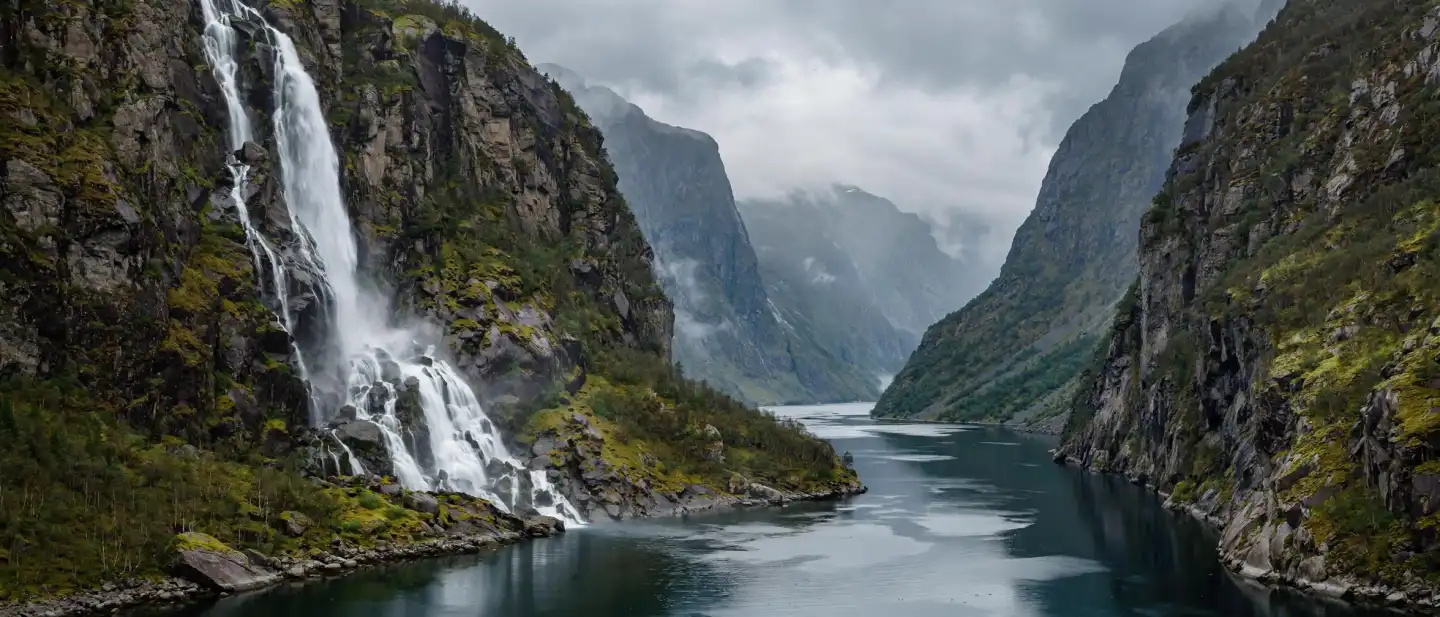
The best time to visit the Norwegian fjords is June to August, with May and September as quieter alternatives. Summer gives the longest days and the best access to mountain roads and viewpoints. Visit Norway says the Trollstigen road and plateau are usually open from mid-May to October or November and close in winter, and that some Norwegian Scenic Routes close in winter too.
Fjord Norway has a coastal climate, with lots of rain and wind near the open sea, while the inner fjords are generally drier and sunnier. MET Norway averages for Bergen show May as the driest month at about 106 mm, and September to November as the wettest at 259–283 mm a month.
Summer is also when the fjords are busiest. Statistics Norway counted about 658,000 foreign guest nights in Vestland, the county that includes Bergen and the Sognefjord, in July 2025, against about 59,000 in January.
If you want fjord scenery with fewer people, aim for late May or early June, when Visit Norway notes fruit trees are in blossom in Fjord Norway, or early September. Book ferries and rooms early for July and August.
When to sail the Hurtigruten coast
The Hurtigruten coastal route can be sailed year-round, so the best time depends on the light you want. Hurtigruten's classic Bergen–Kirkenes–Bergen voyage takes 12 days, covers about 2,500 nautical miles and calls at 34 ports in each direction, a route the company has sailed since 1893.
In winter, the voyage runs under the auroral oval, with dark skies away from town lights, which makes it a popular way to look for the Northern Lights. Weather still matters: cloud can hide the aurora on any night, and the far north has polar night from late November to January.
From late May to early August, Hurtigruten says the midnight sun shines around the clock north of the Arctic Circle. Spring sailings combine sunshine with snow on the mountains, and autumn brings red and gold forests along the coast.
For UK travellers, the voyage pairs well with a flight into Bergen, about two hours from London, at one end. You can also sail a single direction rather than the full round trip, which suits a shorter holiday.
Worst time to visit Norway, and why
October and November are the months most travellers should avoid. MET Norway averages show Tromsø's wettest month is October, at about 131 mm, and Bergen gets 271 mm in October and 259 mm in November. Days are short, the aurora is often hidden by cloud, and the polar night begins in the north at the end of November. Statistics Norway counted fewer foreign guest nights in November 2025 than in any other month.
For the Northern Lights, avoid mid-April to mid-August. Visit Norway's aurora season ends in late March, and the midnight sun keeps the northern sky light from May to July.
For scenery without crowds, avoid July. It was the busiest month in 2025, with about 2.87 million foreign guest nights across Norway, almost five times January's figure. Fjord villages, scenic roads and boat trips are at their fullest.
Winter is not a bad time, but it is a specialist one. Some mountain roads and scenic routes close, Trollstigen among them, and daylight is short even in the south. If you want a classic fjord trip with hiking and drives, winter is the wrong season.
Weather hazards: winter driving, avalanches and mountain weather
Norway's main hazards are winter roads, avalanches and fast-changing mountain weather. The FCDO says you must use winter tyres with at least 3 mm of tread if snow or ice covers the roads, and that snow chains or studded tyres may also be needed.
Before heading into mountain terrain in winter or spring, check the Norwegian Avalanche Warning Service, as the FCDO advises. The FCDO also warns that extreme weather, floods and landslides can happen, and that you should follow the advice of local authorities.
Summer has its own risks. The FCDO says the weather can change quickly, producing Arctic conditions even in summer on exposed mountain tops, and that wind chill is severe in exposed areas. Nearly half of Norway lies within the Arctic Circle, where emergency medical help and search and rescue are limited.
Roads are part of the picture too. Visit Norway says Trollstigen closes in winter and can close at short notice in heavy rain. Some Norwegian Scenic Routes close in winter, so check road status before planning a self-drive itinerary between October and May.
Festivals and events in Norway by month
Norway's events follow its light. In February, Tromsø hosts the Northern Lights Festival (Nordlysfestivalen) in the depths of the Arctic winter; the organiser lists 11 to 20 February 2027 for the next edition. It is a good reason to plan a February aurora trip, but rooms in Tromsø fill quickly around those dates.
In late spring, the Bergen International Festival takes over the city. The organiser's dates for 2027 are 26 May to 12 June, which overlaps May, Bergen's driest month, and the long evenings of early summer.
In June, the Midnight Sun Marathon is run through Tromsø under the never-setting sun. The organiser has set 19 June 2027 for the next race, and says the 2026 edition attracted 9,000 runners from 97 nations, so book accommodation early if your dates overlap.
Dates change each year, so always check the organiser's own website before you book. Big events in smaller cities such as Tromsø and Bergen can tighten hotel availability for the whole week.
Planning a trip to Norway from the UK
Norway is a short hop from the UK. Visit Norway gives a flight time of about two hours from London to Oslo and from London to Bergen. For the Arctic north, Northern Norway's tourist board listed winter 2025/26 nonstop routes to Tromsø of about 3h 30m from London Heathrow (British Airways), Gatwick (easyJet and Norwegian) and Luton (Wizz Air), about 3h 15m from Manchester (easyJet and Norwegian) and about 3h 25m from Bristol (easyJet). Winter 2026/27 schedules should be checked with the airlines.
All of Norway uses Central European Time, so it is one hour ahead of the UK. The currency is the Norwegian krone (NOK).
UK school holidays shape demand. Statistics Norway's 2025 figures show UK guest nights peaking in August and July, with February, the month of the UK half term, next. In Troms, UK guest nights were highest in December.
Norway is in the Schengen area. The FCDO says British visitors can stay up to 90 days in any 180-day period without a visa, that the EU's Entry/Exit System (EES) is being implemented, and that you need your passport for Svalbard. The EU's ETIAS travel authorisation is not yet operating. Check the live FCDO page before you travel.
Frequently asked questions
June is the best all-round month to visit Norway: long days, the midnight sun in the north, open mountain roads and fewer visitors than July. For the Northern Lights, choose February or March instead, when the far north still has dark nights but is drier than early winter and the days are getting longer.
The Northern Lights in Norway can be seen from late August to late March, according to Visit Norway, with the darkest skies from November to February. February and March are often a good choice in Tromsø, because MET Norway averages show they are drier than October to December. Peak viewing is often between 23:00 and 02:00.
The midnight sun in Norway depends on how far north you go. Visit Norway lists 20 May to 22 July in Tromsø, 28 May to 14 July in the Lofoten Islands, 4 June to 8 July in Bodø and 14 May to 29 July at the North Cape. On Svalbard it lasts from 20 April to 22 August.
The polar night in Tromsø runs from the end of November to the middle of January, when the sun stays below the horizon. Visit Norway says it is not pitch black: clear days bring midday twilight and colourful skies, and long nights mean more chances to see the Northern Lights.
The best time to see the Norwegian fjords is June to August, when days are longest and mountain roads such as Trollstigen are open; it is usually open from mid-May to October or November. Late May and early September are quieter alternatives. Avoid the autumn rains: Bergen averages 259–283 mm a month from September to November.
It depends on where you are. The west coast is very wet: MET Norway averages show Bergen getting about 283 mm in September and 271 mm in October. Oslo is much drier, with 36–90 mm a month. In Tromsø, October is the wettest month and May the driest. Inner fjords are generally drier than the coast.
November is the quietest time to visit Norway. Statistics Norway recorded fewer foreign guest nights in November 2025 than in any other month, with January and April also quiet. The catch is short days and wet weather. For a quieter trip with better conditions, try late May or early September, either side of the summer peak.
A nonstop flight from London to Oslo or Bergen takes about two hours, according to Visit Norway. Flights from London to Tromsø in the Arctic north take about 3h 30m, and from Manchester about 3h 15m, on the winter-season routes listed by Northern Norway's tourist board for 2025/26.
Yes, in winter. For winter 2025/26, Northern Norway's tourist board listed nonstop Tromsø flights from London Heathrow, Gatwick and Luton, Manchester and Bristol, run by British Airways, easyJet, Norwegian and Wizz Air. Most ran from October, November or December to March or April. Check the airlines for winter 2026/27 schedules.
No. Norway is in the Schengen area, and the FCDO says British passport holders can visit for up to 90 days in any 180-day period without a visa. Your passport must meet Schengen issue and expiry rules, and you may need to register fingerprints and a photo under the EU's Entry/Exit System. Check the live FCDO page.